
Welcome to Hope Sparks. I write for people standing at thresholds—the uncomfortable edges where who you’ve been meets who you’re becoming. The places where you know something needs to shift, but you’re not quite ready to let go of what’s kept you safe.
If you’re here, you’re probably navigating a transition you didn’t choose, or finally choosing one you’ve been avoiding. Either way: I see you. And I’m glad you’re here.
Friends and followers have requested I speak my post so they can listen while on the go. If you’re not up for reading, or prefer audio, click the link above. xH
Last week I promised you more on ventilation. Here it is.
But I want to start somewhere I didn’t expect to start when I sat down to write this.
The loop closing
My daughter Sophia is heading to Dalhousie University in the fall. My alma mater. The place where I studied Sociology and first learned to watch human behaviour as a system, where I found the part of my mind that asks: what patterns are actually running underneath what people say they’re doing?
That mind is the one I’ve built everything from. My coaching, my frameworks, the way I read a room, the way I’m reading this moment we’re all inside of right now.
And she’s walking through the same door.
There’s a loop closing in my chest about it. I keep reaching for a word and landing on awe.
And then there’s the other thing.
Ten years out
I was in the car the other morning, driving to the dentist, talking to my brother James. We do this thing sometimes where we project forward ten years and try to imagine honestly what we’ll be looking at. I found myself stumped by my own questions. What will her degree actually prepare Sophia for? Which parts of what she learns will still be relevant in the changing world? Which industries, which ways of working, which fundamental assumptions about what a trained human mind is for, will have shifted underneath her while she was studying?
I didn’t have clean answers. I still don’t.
What I kept coming back to wasn’t Sophia specifically. It was the wider thing I keep watching from where I sit: whole industries renegotiating what human contribution actually means. Companies redesigning themselves around what AI can do faster, cheaper, and with less complaint than a person. The questions my clients bring me aren’t abstract. They’re sitting in the middle of these redesigns in real time, trying to figure out what’s still theirs to hold.
And when I imagine Sophia walking into that, I feel both things at once. The awe of the loop closing. And the genuine not-knowing of what world she’s walking into.
I’m not catastrophizing. I’m just not pretending I can see clearly either.
What we’re quietly letting go
Philosopher of education Zak Stein has a name for something I keep bumping up against. He calls it cognitive atrophy: the gradual erosion of a capacity you once had, not because you lost it suddenly, but because you stopped needing it. His analogy is GPS (which speaks to me as I no longer know where I’m going without my trusty iPhone GPS on). Use it long enough and the internal compass you spent years building goes quiet. The neural map fades. You’d have to rebuild it deliberately if you wanted it back.
But with young people, he says, the problem is different. Not atrophy. Something more permanent. If you never build the capacity in the first place, because the tool was always there to do it for you, there’s nothing to atrophy. There’s just an absence where the skill was supposed to form.
That’s what sits in my chest when I think about Sophia at Dal, and about the leaders I work with redesigning their organizations around these tools right now. The question underneath every conversation: what are we keeping? What are we quietly letting go without deciding to?
Attention vs. attachment
Stein makes another distinction.
We all know social media has hacked our attention. AI, the anthropomorphic kind, the kind that responds to you and seems to know you, is doing something different. It’s reaching for our attachment system. Attention is a resource you can reclaim. You put the phone down and it comes back. Attachment is structural. It’s how we form bonds, how we orient ourselves in relation to others, how we know we’re not alone. When something simulates that bond with frictionless availability and no inconvenience, no bad moods, no needs of its own, the nervous system can start to prefer it. Not consciously. Incrementally. The way water finds the easier path.
I’ve been watching this in many areas of life around me. In teens spending more and more time bonding with AI bots because they’re just easier than facing fellow teens. In my coaching of leaders who are preferring to brainstorm with AI over fellow humans. I’ve been watching it in myself, spending more time learning AI tools to better understand the space, and getting sucked in for hours at a time.
The emails that arrive in your inbox that are technically correct and completely empty. Messages with all the right words in all the right order that somehow say nothing. Flat. Thin. Like talking to a room that looks like a room but has no air in it. The texture of a person’s thinking, gone. Even the endearing clunkiness of how someone actually puts words together. Gone.
I’ve caught it coming out of my own mouth. A perfectly constructed sentence that I felt nothing while saying. That landed nowhere in my body before it left my lips. That’s the insidious part. It doesn’t announce itself. It just quietly stops feeling like you.
The horse half
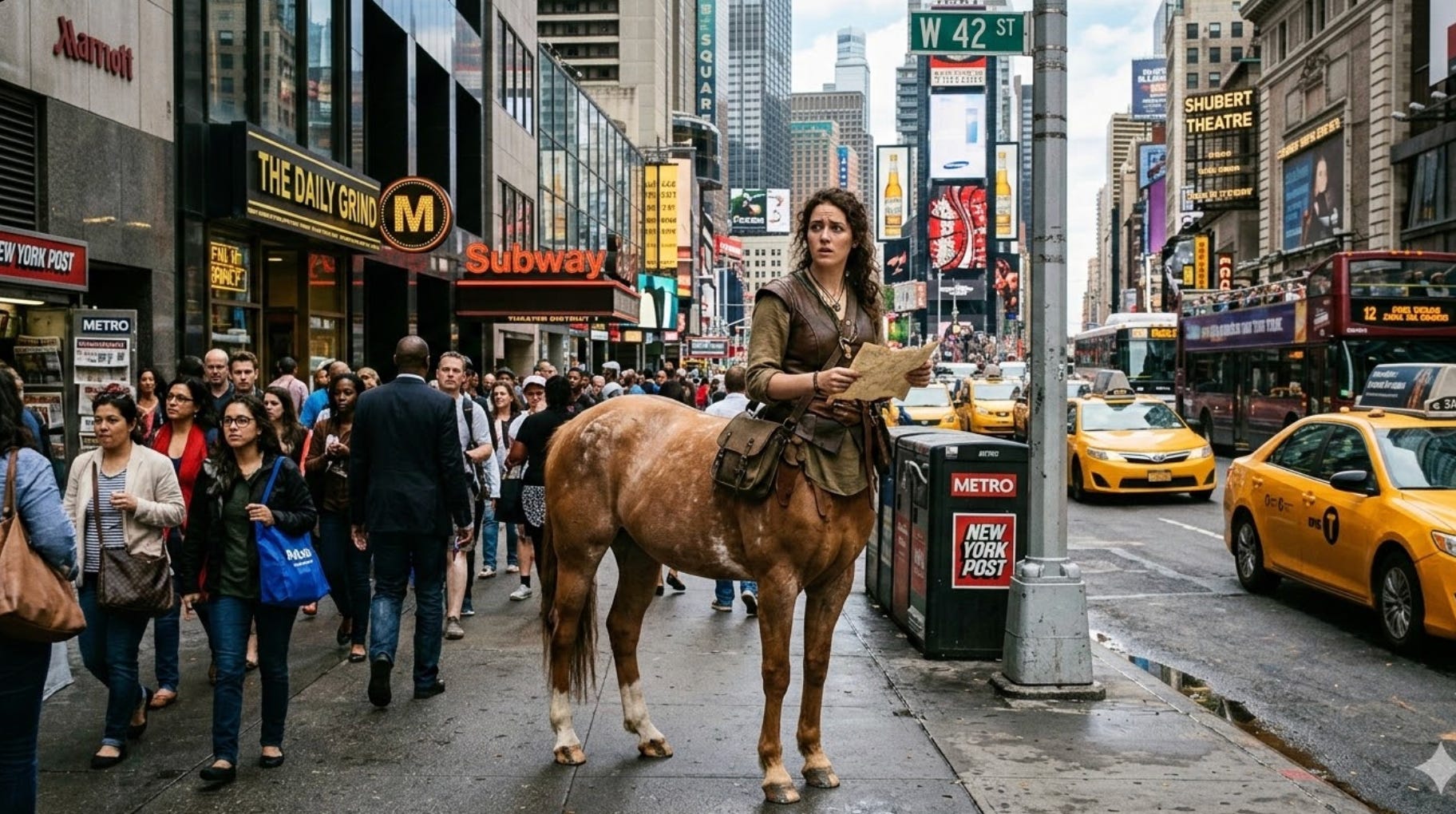
I used Gemini’s Nano Banana image generator for this centaur.
Some of my collaborators working deep in AI describe what we’re becoming as centaurs. Half human, half something else. The human half still embodied, still moving through the world with a nervous system, a body, relational needs, sensory memory. The other half fused with something computationally vast.
It’s a compelling image.
What I keep coming back to is the horse half. Not as metaphor. Literally: the part that moves through the world in a body, that needs ground under its feet, that orients by smell and sound and the warmth of other creatures nearby. The part that can’t be uploaded. The part that atrophies first when we stop using it, because it requires the least justification to neglect.
My sociology mind from Dalhousie keeps surfacing here. We are creatures whose entire developmental architecture, from infant attachment through adult connection through the grief we feel when community breaks down, is built around the irreplaceable fact of other human beings in the room. Not performing presence. Actually there. Breathing, warm, inconvenient, fully themselves.
AI offers something that feels like that. It doesn’t give us that. And the nervous system, already stretched thin and lonely in ways this culture hasn’t fully reckoned with, may not always know the difference until it’s been a long time since it got the real thing.
The question I keep sitting with: how do you honour the horse half when the human half has access to something this powerful?
I don’t know. This is the open question.
What ventilation actually looks like
So. Ventilation.
Letting the air back in.
For me this looks like mornings. I’ve always been an early riser, not because of any productivity philosophy, but because early morning is when I can feel my brain clear and rested and mine. Before the day makes its demands. Before the screen pulls.
I come downstairs slowly. I make my coffee. I don’t look at my phone.
I pull out my journal and write a thought download first. Whatever is running in my mind, conscious and unconscious, gets put somewhere outside of me. Then gratitude. Not as a ritual but as a deliberate act of attention, pulling toward me the things I want to notice, to cherish, and not let slip past.
I write by hand, with a Staedtler mechanical pencil I’m currently obsessed with. There’s something about watching my own (cramped) handwriting appear on the page. Feeling it. It’s mine in a way that typed words aren’t quite.
Sometimes I pull a card from Kim Krans’ archetype deck, letting it rustle into my subconscious and surface a theme. Sometimes I read. Right now I’m deep in re-reading Catherine MacCoun On Becoming An Alchemist - A Guide For the Modern Magician, which is profoundly wise and also unexpectedly funny, and I have a physical copy to weather with my hands, because that matters. Sometimes I sit in meditation with my bros James in his morning sit. Sometimes I dance to a soulful Spotify mix, choosing a tune to lead me in movement. Always I walk my dog Bee for her morning pee. Slowing down to watch her sniff every spec. Sunlight on my eyeballs, actual ground under my feet.
This is ventilation. Not productivity. Not optimization. Just: being a human being before I become a human doing.
The inner infrastructure
Here’s what I know after this winter of building.
The people who will use AI well are not the people who use it most. They are the people who know themselves clearly enough to stay in the driver’s seat. Who can feel the difference between thinking with AI and outsourcing their thinking to it. Who have enough inner infrastructure that the speed doesn’t sweep them away.
That inner infrastructure is what I’ve been building for years in my coaching work. Turns out it’s exactly what this moment requires.
I’m not advocating for less AI. I’m advocating for more you. The tool isn’t the problem. The question is who’s holding it, and from what place in themselves.
What I keep asking the leaders I work with is simple: what’s your recipe for using AI to retain your humanness? Not mine. Yours. What does it feel like when you’re thinking clearly, when your voice is still in the room, when you’re using the tool rather than being used by it? Because that felt sense, that capacity to notice the difference, is the thing worth building. It doesn’t come from willpower. It comes from knowing yourself well enough to catch the drift before you’ve gone too far downstream.
That’s the work. And it’s available to anyone willing to get curious about their own inner weather before they open the laptop.
Your depth is not the obstacle. Your depth is the point.
Word of caution… if you can feel a plastic-brain buzzy tiredness, the stretched and strange and not-quite-right feeling from using AI, that’s your nervous system asking for air.
Give it some.
In the room together
I’m offering two gatherings this spring-summer that are ventilation practices.

Aesthetic Japan Journey
This May, my husband Charlie and I are co-guiding the final spot on an Aesthetic Japan journey, May 6-15. Ten days. Eight people. Tokyo, Kanazawa, Yamanaka Onsen, Kyoto. Slow immersion in a culture that has spent centuries perfecting the art of noticing. Artisans. Dry gardens. Ryokan. The kind of travel that puts you back in your body because the whole country is designed to arrest your attention in the physical world.
One spot left. If it’s calling you - explore HERE.

Generation Medicine Gathering
This June 18-21, I’m joining Julian Guderley and my mentor Phil Moore for our forth Solstice gathering at Highland Lake Cove in the Blue Ridge Mountains of North Carolina. It’s our dose of #GenMed as we affectionally call it. Intergenerational. Embodied. The kind of event that has been happening in human communities for thousands of years: people gathering at a threshold moment in the calendar, bringing themselves rather than their productivity, paying attention together.
Spots are limited and going fast. You can find the details HERE.
These aren’t vacations. They’re the horse half.
Hit reply. I read every one.
I’d love to know: what does ventilation look like for you right now? What are you doing to stay human while the world speeds up?
In your corner, Hope